Tourmyindia.com
Tour My India Complete Travel Portal for your holidays in Tawang Monastery Get complete information on Tawang Monastery, Arunachal Pradesh Hotels, Tawang Monastery Travel,Tawang Monastery Tours, Arunachal Pradesh Tourism, Arunachal Pradesh Tourist Attraction, Tawang Monastery Arunachal Pradesh , Hotels in Arunachal Pradesh, Tawang Monastery Travel Agent, Arunachal Pradesh Tour Operator, Monasteries in Arunachal Pradesh, Travel to Tawang Monastery, Cities in Arunachal Pradesh, Arunachal Pradesh Monasteries, Tawang Monastery Culture, Arunachal Pradesh Tour Packages, Tawang Monastery tour packagesl, Arunachal Pradesh Destination, Tawang Monastery, Travel Agents for Tawang Monastery, Tawang Monastery Tourism, Tawang Monastery Travel, Tawang Monastery Pilgrimage Centers, Urgelling Monastery, Tawang Monastery Hotels Guide.
Package Tours | Book A Hotel | Rent A Car | Air Tickets
Find What you are looking for

Home


Andhra Pradesh
Arunachal Pradesh

Assam

Bihar

Chhattisgarh

Delhi

Goa

Gujarat

Haryana

Himachal Pradesh
Jammu & Kashmir Jharkand
Karnataka

Kerala

Madhya Pradesh

Maharashtra
Manipur

Meghalaya

Mizoram
Nagaland

Orissa
Punjab
Rajasthan
Sikkim
Tamil Nadu
Tripura
Uttaranchal

Uttar Pradesh
West Bengal


     Union Territories

Andaman and 
      Nicobar Islands

Chandigarh
Dadra and Nagar       Haveli 
Daman and Diu
Lakshadweep
Pondicherry


Indian States
Arunachal Pradesh
General Info | Cities | Wildlife | Festivals | Map | Attractions | Hill Station | Pilgrimage | Hotels

TAWANG MONASTERY

Location: 180-km From Bomdila, Tawang District, Arunachal Prdesh
Founded By: Merak Lama Lodre Gyamtso In 17th Century
Also Known As: Galden Namgyal Lhatse
Significance: Largest Monastery In India And 2nd Largest In Asia.

A Picturesque Location
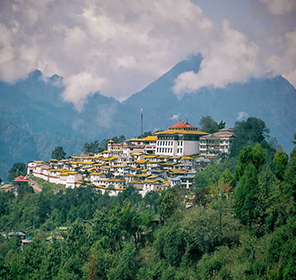
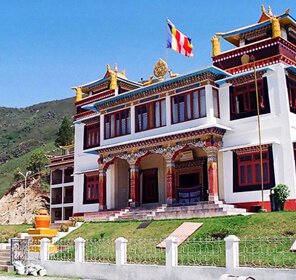
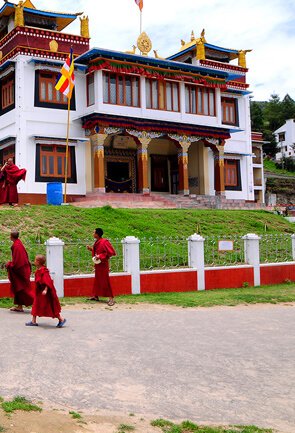
Merak Lama Lodre Gyamtso founded the famous "Galden Namgyal Lhatse", popularly known as Tawang Monastery in the year 1860-61. The monastery stands on the spur of a hill, about 10,000 feet above sea level and has ravines in the south and west, narrow ridge on the north and a gradual slope on the east.

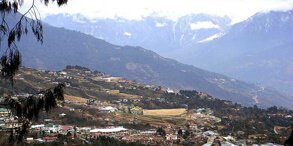
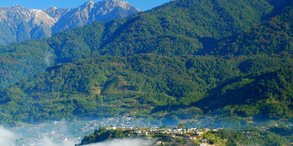
It offers a commanding and picturesque view of the Tawang-Chu valley. From a distance it appears like a fort as if guarding the votaries in the wide valley below. Tawang monastery is the largest of its kind in the country and 2nd largest in Asia. Though it has the capacity for housing about seven hundred monks, the actual number of resident Lamas (Monks) at present is a little more than 300. This monastery is the fountainhead of the spiritual life of the people of this region.
Approach And The Entrance
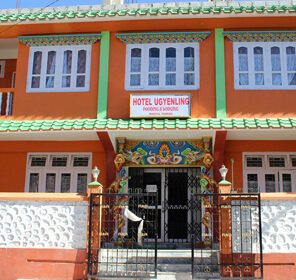
The approach to the monastery is from the north along the ridge. Just near the entrance to the monastery there is a building housing the "Dung-Gyur Mani" from where the water is fetched for use in the monastery. To the south of it is the 'Kakaling', the entrance gate. The Kakaling is a hut-like structure with its two lateral walls made of stone. It serves as a gate. The ceiling the Kakaling is painted with Kying-khors (Mandalas). The inner walls are painted with mural of divinities and saints. After passing through the Kakaling there is a big gate further south which is without any door.

Further south stands the main gate of the monastery, which is fitted with huge doors and is set in the northern wall of the monastery. The eastern wall starts from the open outer gate and encloses the entire eastern side of the monastery. It is about 925 feet long and the height varies from about ten to twenty feet. There is another gate near the southern and of this wall. It is fitted with a huge door.

Near it there are two slits in the wall to see out through and for placing muzzle-loaded gun to fire upon the approaching enemy. A narrow path runs all along the outer side of the eastern wall connecting this gate with the Kakaling. It is said that the yarn given by the Vth Dalai Lama to Merak Lama enclosed the area bounded by the four walls.

The Court
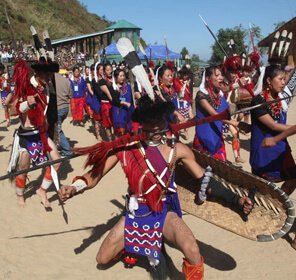
A paved path runs from the main gate toward rear of the monastery and leads to a stone slabs court. Religious dances and outdoor ceremonies are held in this court. The entire eastern half of the monastery is covered with sixty residential quarters called "Sha"(hut) for housing the resident monks. Each of these dormitories has been constructed by a group of villagers on voluntary basis. They also carry out the repairs and are responsible for its maintenance.

A three storied building stands on the western side of the court. It is the "Par-khang" (Library). All the Holy Scriptures including a long two-storied building flanks the southern side of the court. A part of this building is used as store for the provisions of the monks. The Dra-tsang buk and his entourage occupy the other part. A two storied building, on the eastern side of the court is called "Rhum-khang", which is used for cooking the food-offerings for the rituals as well as refreshments for the monks on ritual days.

Assembly Hall - Dukhang
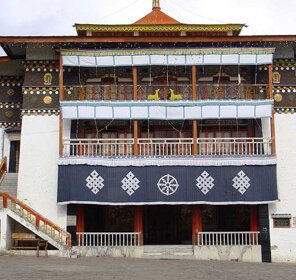
The most imposing building of the monastery is the assembly hall known as "Dukhang". It is a three-storied building standing on the northern side of the court and houses the temple and the "Labrang" (The establishment of the Abbot).

The inner walls of the Dukhang are painted with murals of various divinities and saints. The altar occupies the entire northern wall of the hall. On the left of the alter is the silver casket wrapped in silk containing the Thankas (also spelt as Tankas or Thangkas) of Goddess Sri Devi ("Palden Lhamo") the principal deity of the monastery, which was given to Merak Lama by the Vth Dalai Lama. The Thankas was painted with blood drawn from the nose of the Vth Dalai Lama. The said painting came to be known as "Ja-Droi-ma", which means it had warmth of a bird, which symbolized that the Thanka was of a living type.

A colossal richly - gilded statue of Lord Buddha occupies the middle of the northern side. It is seated on a platform and its body, rising up, terminates in a huge head above the first floor. It is the largest image of the monastery and is about 26 feet high.

A Buddhist Cultural Centre
The monastery also has a Centre for Buddhist Cultural Studies where young monks are taught Arithmetic, English, and Hindi besides traditional monastic education.

In brief, this monastery is simply awe-inspiring and majestic in its appearance and grandeur. A visit of Tawang Monastery is most spiritually refreshing experience.

HOW TO GET THERE
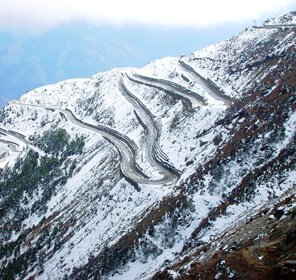
Road: The only way out of the Tawang town leads back over the Sela Pass and down to Bomdila. Arunachal State Transport runs buses to Bomdila on Wednesday. Friday And Saturday (8hr). Private buses also run daily via Bomdila to Tezpur, departing round about noontime and arriving Tawang early in the morning of the following day. Jeeps also leave daily for Tezpur early in the morning from Tawang City Gate, 200m downhill from the bus stand.

Cities:-

-: Cities in Arunachal Pradesh :-

Destination India
Maps Of Indian Cities
Hot Destinations
Beaches In India
Hotels/Resorts
Tourist Attractions
Treks in India
 

TourMyIndia.com, Online Tour Operator in India for Tour Packages, Car / Coach Rental Services, Hotel Bookings and Air Bookings

*(represents Compulsory Fields)
*Name : No. of Persons :
*E-Mail : Date of Arrival :
Phone :
(including area code)
Duration of stay : Days
*Country :    
*Describe Your Requirements: